Tag: Society

  • To Venn or to Nest?

    Ah, the ubiquitous Venn Diagram! The zenith of all complex systems thinking.

    If it can be encapsulated in a Venn then you’ve really been doing some thinking and managed to capture your feedback loops and relationships within a few brief words and some overlapping shapes and can call it a day.

    But, do I have a curve ball for you.

    How about the nested diagram? Here, we can encapsulate the vastness of the economic problem and shrink it, effortlessly, to fit within the constrains of the environment. Voila! An economy that is right sized.

    It looks a little like this:
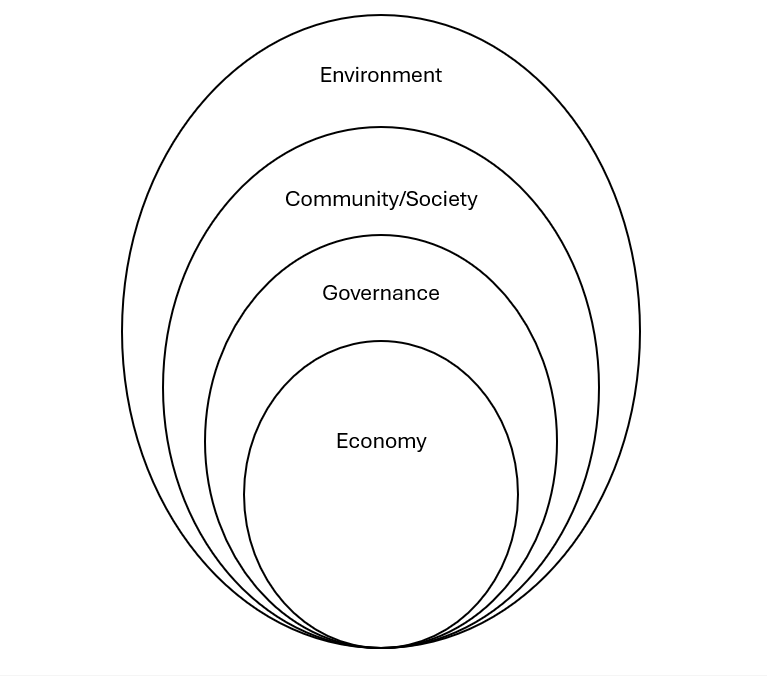
    Look at that! No longer do we need to struggle to balance a hungry economy with a finite planet or an exhausted and disconnected peoples. Instead we see that the economy’s rightful place is seated neatly within the context of good governance, which in turn sits within the context of good relationship, which in turn is comfortably homed within the confines of a limited, balanced and healthy ecosystem.

    No longer are we, misguidedly, giving the economy an equal weighting of importance. No, without the economy governance, relationships and environment can continue.

    Without people the environment will happily carry on, but the need for governance or an economy merrily vanishes. Snap!

    Without the environment, there is nothing.

    Now there may be some debate over whether governance is needed. In fact, I have read one champion of cryptocurrency declaring that part of the allure of cryptocurrency was its existence outside of the existing governance structures. That is all an experiment that I don’t feel qualified to comment on, however, my personal sense is that an economy requires some form of governance, as the economy in itself has just one value: more, which is not enough to maintain civility let alone propriety.

    I would like to see the nested model overtake the venn model (does anyone remember the three pillars model? That was early sustainability talk. The venn took over and now the nest needs to succeed them both).

    The test that nest is best is simply this: take away one element and what remains? If environment everything else distintegrates, if people well the environment happily continues on its way, and if economy why those ingenious people manage to find another way to exchange value. Weighting economy equally with both environment and society is old-school thinking. It’s time to put things in their rightful places.

  • Grocery Lives

    Sometimes, when I am waiting in line at the Supermarket checkout, I stare, dully, at the groceries of whoever is ahead of me, and because I am a sticky-beak I put the story all together in my mind. A story which is full of questions. I wonder how much you can tell of somebody by their groceries.

    There is the older woman, she must be a pensioner, she buys the barest of essential ingredients. Milk. Tinned fish. Rice. Pasta. Tinned tomatoes. Onions. Bread. A few cup-o-soups. They are all home brand. I wonder if she has children, how old they are, if they live near her, if she has grandchildren, what has happened to bring her to this point where affording the simplest of groceries is difficult. Maybe, though, she is quite wealthy and saving even the smallest amounts of money on her food is strangely satisfying to her, a way she can feel in control of her life, of her expenses. Perhaps money is something to be squirreled away instead of spent on living.

    A shiny woman in her thirties. Her hair is voluminous & well cut, she is about a size 18-20.  Her clothes look expensive, but she is bulging out of them.  There are two types of women in this category.  Those who buy cake and those who buy diet soft drinks.  One doesn’t care, loves her size, flaunts it and enjoys her food; the other one is really trying…but not really.  I’ve been in the overweight camp after each of my pregnancies, and it is hard to lose it, so I sympathise.

    The trendy looking couple, with fair trade everything.  Checking the back of every label.

    I like to note how many fresh ingredients I see in peoples trolleys. Sometimes it is hugely encouraging, seeing the clearly competent and confident mums with trolleys full of greens, other times a sad commentary on the state of our food system, with near everything in said trolley in a plastic bag or a brightly coloured box with brand names screaming loudly.

    Well.

    Food has forever been a centrifugal force in relationships and storytelling.  So many stories converge in a supermarket. People passing like trolleys in the aisle, words unspoken, but the contents of trolleys speaking volumes, uttering a myriad of questions, stating simple facts about this increasingly complex world. Supermarkets are an icon of lost community, where even getting food is done without any need for relationship, especially with the introduction of self-serve checkouts, before these however ‘checkout chicks’ were merely human machines, just another cog.

    This is the 20th century version of foraging. With the 21st century still in its infancy I wonder what they’ll think of next. I wonder if I will like it.