Tag: community

  • Deep roots grow strong trees

    “I used to think that top environmental problems were biodiversity loss, ecosystem collapse and climate change. I thought that thirty years of good science could address these problems. I was wrong. The top environmental problems are selfishness, greed and apathy, and to deal with these we need a cultural and spiritual transformation. And we scientists don’t know how to do that.”
    — James Gustave Speth

    [This is part two of The Social Side of Climate Change.]

    I’d like to return to the idea, in part one, that connecting our children with nature is key to unlocking both the passion and creativity to address the environmental (and perhaps social) issues facing us today.

    I would argue that our disconnection with nature has paralleled a disconnection with ourselves and one another. We do see this in the ways we relate to one another, very often through screens. Previously our schools, workplaces and families were places to grow in relationship. Critical spaces to test what’s permissible and possible within our relationships. The petrie dish, the first battleground is the family, something I’ve witnessed first hand. Difficult children need more time, more guidance. They need to make trouble in order to learn where and when to stop. This can’t be done if children are more attached to screens (much easier for parents!) than arguing around a board game. We have one child in particular who is very painful to play board games with – they are now in their teens – but we persist. With every argument I remind myself that this is their chance to learn social skills. The siblings often get the worst of their brothers or sisters, but they are all learning and it’s the parent who is most connected to be able to guide them.

    That’s a hard task, not for the faint of heart, the tired or the distracted. Things I and us all have been. And we’re allowed to be. That’s their chance to learn to give space.

    So the social nature of relationships is challenged by our current social cultures.

    Our nature-relationships are also challenged.

    Whereas, once before, outside play made up most of the domain of the young, here they are again constricted from very early ages to an outdoor space the size of a pen. If they walk outside those boundaries they hold hands and cross roads in straight lines, sticking to concrete paths and adult guidance. Gone are the days where mum and dad sent the children of the neighbourhood off together in a group down to the creek to fish with home made rods and hooks, maybe even a bow and arrow slung over a shoulder. Even playing cricket on a nearby oval, away from adult supervision, is a rare thing.

    This disconnection from nature doesn’t allow a child – who becomes an adult – to develop an intuitive sense of the natural world, to observe its rhythms and subtle and intricate interlinkings, to witness the relationship of the wind to the bugs to the birds to the foxes to the rabbits to the pollen to the grass heads to the leaves as they drop in autumn. They don’t see the old wombat hole overgrown with blackberries or the new burrow in the bank of a river.

    They don’t observe how the beautiful Orchard Swallowtail butterfly is the adult of the exquisite, scented caterpillar eating most of the lemon tree’s leaves. They can’t connect that the prolifigation of Painted Lady butterflies is a direct result of the nettle plants that were left to self seed over winter.

    They don’t realise that the answer to the mouse plague is to tolerate the snakes that come up from the nature reserve. They don’t observe to recognise that the snake is more scared of them than they are of it, and it’s more interested in the mice than the human. They don’t see the birds dying in their nests because of the poisoned mice now running from the homes where bait is used to attempt to control the plague.

    If they don’t see this, they don’t get the chance to care. They don’t develop the memory of seeing a sickly bird crouching in its nest, eyes opening and closing slowly as it quietly waits for death to come; or watching a smooth, silky snake swallow a mouse hole before sliding away again; or seeing a fat, brown wombat’s bottom wiggle into the hole it is digging out from under it. Then, as an adult, the plight of the poisoned bird, or the decline of butterflies in a suburb dominated by artificial grass, is so separate from the person as to seem to not even matter to our existence – when this is far, far from the fact.

    A child can quickly become attuned to the balance and imbalances of nature, if we just let them. The chance to sit back and observe nature in action can create children who are able to take stock, put pieces of a puzzle together, be quiet in their own thoughts and allow true creativity to arise – almost spontaneously from the rich hummus of thought that has been allowed to compost in a child’s heart and mind.

    One book I read about this connection spoke of a child in a daycare centre who’s “special place” was sitting, hidden in the one bamboo copse in the corner of the daycare yard. Even in a citified surrounding the child naturally gravitates toward that copse. Not only that, but it was the “special place” of most of the children in that centre.

    In this there is a clue that, building nature-care is as simple as including some wild places in our children’s lives, whether it’s the smallest plot of bamboo, a veggie garden, even a worm farm or a wind chime or an oval on which to watch the clouds. Bringing nature into our children’s lives should be at the forefront of any future-focussed person. Love and instinctive care of the natural world is where any sustainabile living needs to start if it is to be wholistic in scope and effective in practice.
  • To Venn or to Nest?

    Ah, the ubiquitous Venn Diagram! The zenith of all complex systems thinking.

    If it can be encapsulated in a Venn then you’ve really been doing some thinking and managed to capture your feedback loops and relationships within a few brief words and some overlapping shapes and can call it a day.

    But, do I have a curve ball for you.

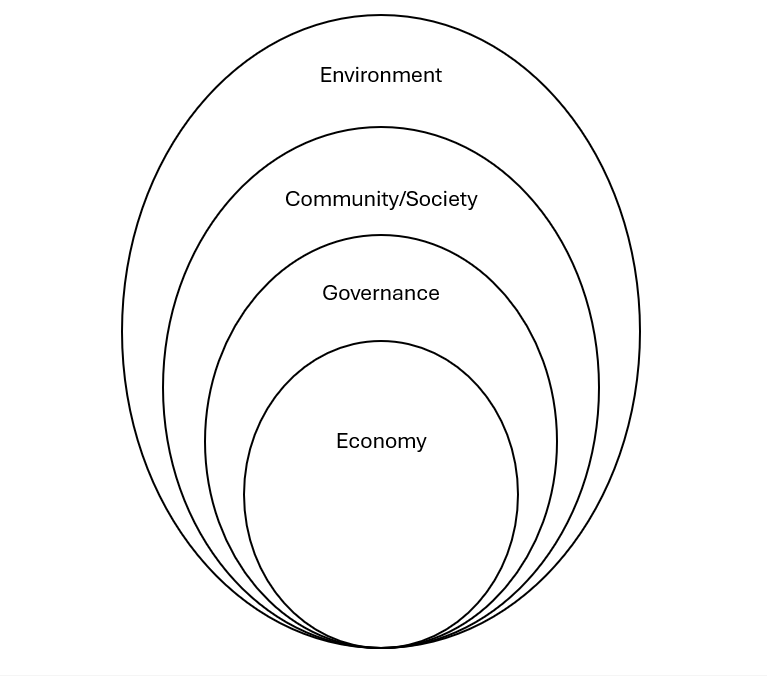
    How about the nested diagram? Here, we can encapsulate the vastness of the economic problem and shrink it, effortlessly, to fit within the constrains of the environment. Voila! An economy that is right sized.

    It looks a little like this:

    Look at that! No longer do we need to struggle to balance a hungry economy with a finite planet or an exhausted and disconnected peoples. Instead we see that the economy’s rightful place is seated neatly within the context of good governance, which in turn sits within the context of good relationship, which in turn is comfortably homed within the confines of a limited, balanced and healthy ecosystem.

    No longer are we, misguidedly, giving the economy an equal weighting of importance. No, without the economy governance, relationships and environment can continue.

    Without people the environment will happily carry on, but the need for governance or an economy merrily vanishes. Snap!

    Without the environment, there is nothing.

    Now there may be some debate over whether governance is needed. In fact, I have read one champion of cryptocurrency declaring that part of the allure of cryptocurrency was its existence outside of the existing governance structures. That is all an experiment that I don’t feel qualified to comment on, however, my personal sense is that an economy requires some form of governance, as the economy in itself has just one value: more, which is not enough to maintain civility let alone propriety.

    I would like to see the nested model overtake the venn model (does anyone remember the three pillars model? That was early sustainability talk. The venn took over and now the nest needs to succeed them both).

    The test that nest is best is simply this: take away one element and what remains? If environment everything else distintegrates, if people well the environment happily continues on its way, and if economy why those ingenious people manage to find another way to exchange value. Weighting economy equally with both environment and society is old-school thinking. It’s time to put things in their rightful places.

  • What I learned from Mohammed Ali

    Last night I had the great joy and privilege of attending HelpingACT’s fundraising dinner at Taj Agra in Dickson.

    HelpingACT “began” in about 2018 with a conversation between two men, Mohammed Ali and Manar Ahmad, with the simple goal of ensuring that no person in Canberra would sleep hungry. Since then this simple mission has galvanised a whole community of people eager to connect over the mission of helping others.

    They received their Registered Charity status only several days ago and so the call was made to host a dinner before the looming end of financial year in order to allow others to take advantage of this little benefit.

    In a spirit which I’ve only ever seen Mohammed Ali generate almost everyone in the room had the chance to say something. As the prepared speeches finished Mohammed began to call on people at a moment’s notice to step up and say something while also calling on us all to continue to enjoy ourselves, enjoy the good food, enjoy the music, enjoy the good conversation. Have fun, laugh and love.

    By the time he called on me I could think of only one thing to say and it’s something that I have learned through Mohammed over the past two years in which I’ve had the privilege to come into his orbit. That is, love.

    Mohammed galvanises people because he loves them and because he has learned how to show them that he loves them. He loves the politicians, the media personalities and managers, the refugees and those he helps all equally. He helps people because he loves them and he also loves to enjoy life, eat and celebrate with the people he loves.

    He equally respects and honours everyone’s contribution and everyone’s story and he is genuinely touched by people’s difficulties and is not scared to bring these stories to the light of day, inviting people to share in the safe space he creates.

    I remember once that his advice about speaking in public was simply to speak from the heart.

    Talking about love is not the corporate thing to do. I’ve been to many awards nights and fundraising dinners where us humans try our darndest to be less human, to bring what we perceive to be ‘our best selves’ into the room. As my cousin said about a new position, “I have to wear a suit and speak funny”, and I laughed because it is true. Being part of the corporate world can be to don a costume and adopt a vernacular which squeezes us humans into the armour of productivity. We can be all too eager to show that we’re worth it, that we’re successful, that we’re like all the other successful, well-put-together people in the room.

    But, there is another way and I never saw it until I met Mohammed.

    The enemy of love is fear. There is a lot of recentish talk about how safe workplaces are the best workplaces. Employees/staff/team members need to feel like their workplace is a safe space to express their ideas, to have a break and enjoy each others company, as it’s been shown that good relationships within the workplace lead to measurable productivity. Until we manage to measure and value other things such as quality of life, richness of experience, connectedness and actual benefits to our environment we can assume that these things too are improved through the natural sport of human beings congregating, communicating and caring. For a great little video on this see Margaret Heffernan’s TED Talk, Forget the Pecking Order at Work. This video, I’m happy to say, was shown to me through graduate studies in Management – so the culture is changing.

    Unfortunately, we have inherited an industrial workplace structure, based on distrust and power (for a great book about this, read the classic book, The Ragged Trousered Philanthropists by Robert Tressell). Performing to a set of KPI’s, watching our words in case of accusation, managing our emotions so as to maintain professionality, kurbing your enthusiasm and silliness! To be sure, some of the best workplaces I’ve been in are where the boss – the CEO – is happy to be a little bit silly. It sets an amazing culture of acceptance.

    Great is the CEO who strikes a balance between passion, hard work and good humour.

    Public speaking especially is often fraught with fear that we will say ‘the wrong thing’ but on the times I’ve opened up about my own story I’ve been surprised by the reactions. It seems we’ve all been there. We’ve all struggled, we’ve all needed a leg up at some point in time. We do carry our personal relationships with us into the workplace. Our mothers and fathers do still loom over us even there. We all still do need reassurance that we are loved. We need to feel valued, we need to feel respected, we need to feel safe.

    Mohammed Ali taught me, and is teaching me, how to create these spaces of safety.

    We thank people. We show our own hearts. We act a little silly to relax the atmosphere. We lose our own self-consciousness so that others drop theirs. We listen with our whole bodies. We enjoy ourselves and invite others to do the same.

    For Mohammed running a charity that feeds people is not about doing good because it’s the right thing to do or because he wants to see change, or because of a religious conviction. Running a fundraiser is not about extracting as much money out of people as possible. It’s about inviting others in to share in the generous experience of life. It’s about enjoying life together, because how can any of us enjoy our own lives fully when we know there are others struggling, sleeping rough or sleeping hungry. We are connected. Our experiences ripple out through time and space and affect one another. If my brother is hungry then I too may as well be hungry. If I am scared then others become more scared.

    Mohammed Ali taught me how to love well. He showed me that we can love in the corporate world, that in fact, we must. He showed me that helping is as much about loving myself as it is about loving others.

    If we really want to be part of changing the world then we have to love others as if they are ourselves. We have to love our earth as if it is ourself. In a way this does entail some sacrifice in order to ensure there is a fair share among all (which includes a fair share for our planet to continue to regenerate and thrive). This could be illustrated in an alternative Venn diagram below.

    Venn diagrams aside, the point is, if we love others and if we love our planet and if we realise that our fullest experience of life is dependent on them also thriving then it’s easy to not take too much. It is easy to consider our own purchases, it is easy to moderate our own wealth in order to share the wealth around because we can not be deeply happy unless our brother or sister is also happy and we can not truly thrive unless our own planet is thriving. If this means we have to cut down on plastic, cut down on travel, cut down on the number of houses we own so that others have a chance at housing security, shrink that “me” circle back to its right size, so that we are not consuming 4.5 planet’s worth of resources while others are consuming mere crumbs, then that’s ok because it’s about all of us together, not one of us alone.

    Mohammed Ali taught me that we are better together. We are better when we are deeply connected to our community through love.

    What better lesson is there.

  • Thoughts on Simplicity

    ‘The Simple Life’ has undergone a few overhauls over the years.  These days minimalism and ultra simplicity seem to be all the rage.  Back in the day ‘the simple life’ or ‘the good life’ equated to some kind of wholesome, outdoor-living, preserve-making, family-friendly, pig-raising escapade.

    Things change and I guess that’s life.

    The thing is, ‘the simple life’ never seems to lose it’s charm, whatever the definition. We seem to be ever searching for ‘a better life’.

    I have been reading a bit and thinking a bit on this new reincarnation of simple living and the thing is: I hope it’s not a fad. But. It will be a fad if the lifestyle is not whole-of-life and sustainable.

    Firstly, I guess the basic premise behind Simple Living is to consume less, take away the unnecessary and only do what’s left or, equally, what you are passionate about. I guess the idea is that you get rid of the things, the tasks, the busyness in order to focus on the relationships with family, friends, society, nature, the world.

    It’s alluring.  I really like this ideal.

    But I’ve noticed a few things. Sometimes when simplifying we can simplify our own lives whilst making other lives more complicated and, inconsiderately, putting undue expectations on others.

    For example:

    Paring back on your own grocery items, cooking basic, bland food, but then relying on other people to feed you your essential vitamins and minerals and your meat (if so inclined).

    Getting rid of your car to either a) take public transport (relies on a reliable and sustainable transport system) or b) rely on other people for lifts (relies on them having a car & money for the petrol) which can put pressure on your community to provide for you, when you are in fact well able to provide for yourself.

    Perhaps choosing not to go outside of your area while expecting other people to come to you.

    Or taking away the television only to expect to visit other people’s places to view the box.

    I guess all these thoughts point to a central idea: In simplifying we must think outside of our own little box/apartment/house/self/family. If simplicity is to last it must be undertaken with the wider community in mind. Consideration of those around you must be your issue.  Expecting other people to provide for your needs (or as one blogger put it: stealing from plates on the dinner table.) builds resentment in the long run and can not lead to a long-term sustainable lifestyle of simplicity as in order for any lifestyle to succeed it must be supported by the community around it.

    It is in the simplicity spruikers interest to encourage, even assist others to pursue simplicity, not simply to use others to maintain ones own lifestyle or budget.

    As my friend says, it’s best to live simply and generously. Simplicity should not stop us from being generous to those around us. And simplifying should not in turn rely on the unending generosity of others, especially when we are well able to provide for ourselves and just choose not to, for whatever reason.

    P.S. Pics and adventure updates to come soon. We’ve been living on low internet for a couple of weeks while away from where home is currently. We are back to high-tech living soon!